


What Is An eCommerce Merchant Account & Why Do You Need One?
Read More
Sep 2, 2025
Filed under: Credit Card Processing, eCommerce
This quick guide talks about how dropshipping works, what it costs, and how to start your own online store.

WRITTEN & RESEARCHED BY
Expert Contributor
Last updated onUpdated

REVIEWED BY
Editor & Senior Staff Writer
Thinking about starting a dropshipping business but not sure how the process works? This guide explains how dropshipping works, what your options are, and what to consider before getting started.
Table of Contents
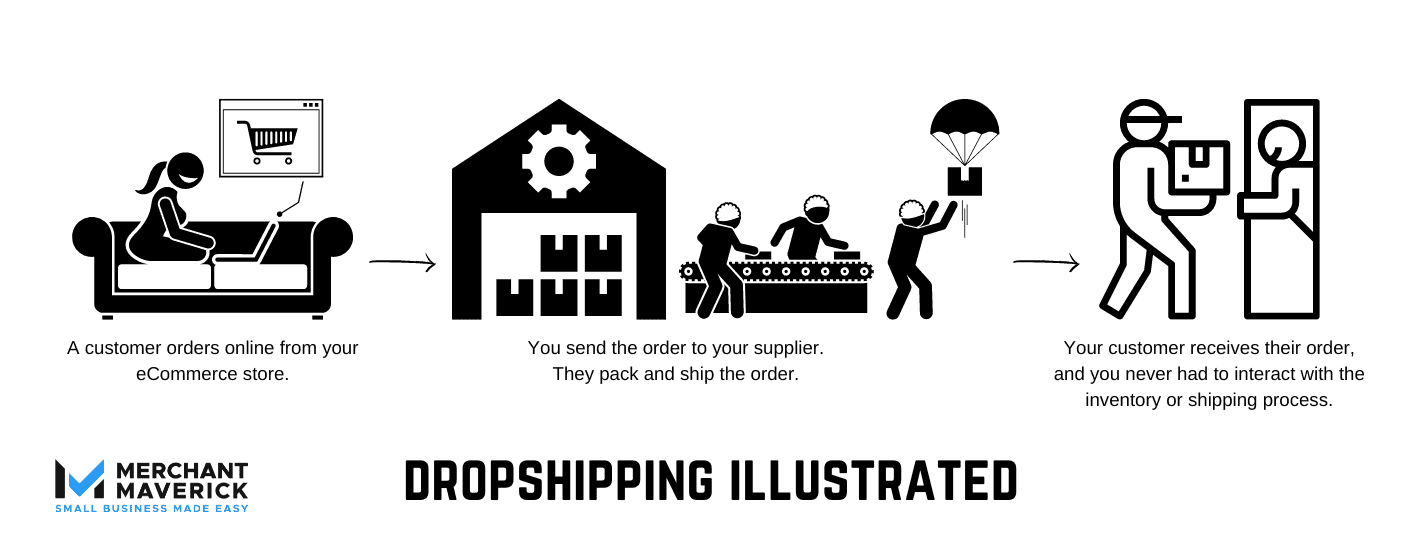
Dropshipping is an eCommerce business model that allows merchants to sell products without purchasing or storing inventory upfront. Instead, the merchant partners with a third-party supplier that fulfills each order as it comes in.
Here’s how a typical dropshipping order works:
Dropshipping has relatively low startup costs and can be managed from almost anywhere. However, competition is high, profit margins are often slim, and merchants have limited control over product quality, inventory availability, and shipping.
Dropshipping has low barriers to entry, but competition can be intense. A clear product strategy, reliable suppliers, and effective marketing can help your store stand out.
First, decide what you want to sell and where you’ll source it.
Browse online marketplaces, supplier directories, and trending product lists for ideas. Before partnering with a supplier, check reviews, research stores that use the company, and order samples to evaluate product quality, packaging, and shipping times.
Businesses selling custom merchandise can also explore print-on-demand services such as Printify or Printful.
Next, decide where you’ll sell your products. You can:
Your own store gives you more control over branding and customer relationships, while marketplaces provide access to an existing audience but typically charge listing, transaction, or referral fees.
Before choosing a platform, compare its costs, dropshipping integrations, payment options, and selling rules.
Once your store is live, you’ll need to attract customers. Common dropshipping marketing strategies include:
Focus on building a recognizable brand rather than relying solely on individual products. Test different marketing channels, track the results, and invest more in the strategies that generate sales.
Dropshipping typically has lower startup costs than traditional retail because you do not need to purchase or store inventory upfront.
However, you should still budget for expenses such as:
You can start with a small budget by using free marketing channels, then increase your ad spending as your store begins generating sales.
Dropshipping offers several benefits:
Dropshipping can work as a standalone business or as one part of a larger eCommerce strategy.
Dropshipping is not a guaranteed path to easy income. Building a successful store still requires strong products, reliable suppliers, effective marketing, and repeat customers.
Dropshipping offers a relatively low-cost way to start an online business, but success still requires research, reliable suppliers, effective marketing, and realistic expectations.
Before launching, compare platforms, order product samples, calculate your costs, and create a clear plan. If Shopify is one of the platforms you’re considering, read our Shopify review to learn more.




Want to help shape the future of the Merchant Maverick website? Join our testing and survey community!
By providing feedback on how we can improve, you can earn gift cards and get early access to new features.
 Whether you're looking to save money on processing or to get approved for a merchant account, PaymentCloud can help.
Get Started
Whether you're looking to save money on processing or to get approved for a merchant account, PaymentCloud can help.
Get Started
Help us to improve by providing some feedback on your experience today.
The vendors that appear on this list were chosen by subject matter experts on the basis of product quality, wide usage and availability, and positive reputation.
Merchant Maverick’s ratings are editorial in nature, and are not aggregated from user reviews. Each staff reviewer at Merchant Maverick is a subject matter expert with experience researching, testing, and evaluating small business software and services. The rating of this company or service is based on the author’s expert opinion and analysis of the product, and assessed and seconded by another subject matter expert on staff before publication. Merchant Maverick’s ratings are not influenced by affiliate partnerships.
Our unbiased reviews and content are supported in part by affiliate partnerships, and we adhere to strict guidelines to preserve editorial integrity. The editorial content on this page is not provided by any of the companies mentioned and has not been reviewed, approved or otherwise endorsed by any of these entities. Opinions expressed here are author’s alone.
Whether you're looking to save money on processing or to get approved for a merchant account, PaymentCloud can help.
Get Started